Transforming Singapore’s Built Environment: A Strategic Pathway for a Resilient and Smart Nation
- Introduction

- The Built Environment Sector: Introduction
The Built Environment (BE) sector forms the physical backbone of a nation’s economy — encompassing the planning, design, construction, and long-term management of the spaces where people live, work, and connect. In Singapore, the sector supports critical national outcomes such as housing, infrastructure resilience, and sustainable urban development. The sector’s transformation is central to achieving productivity and sustainability goals under the Digital Economy and Smart Nation agendas.
2.1. Personas and Context
At its core, the BE value chain is driven by diverse professionals whose roles span the entire building lifecycle — from early-stage conceptualisation to asset delivery and ongoing management. These professionals can broadly be represented by eight key personas, each playing a vital role in improving the sector’s efficiency, quality, and safety outcomes.

At the start of the value chain is the Developer, the primary decision-maker responsible for defining project requirements, funding, and high-level outcomes. Developers seek comprehensive visibility into project performance across cost, quality, safety, time, and productivity dimensions, supported by tools such as digital contract management and data-driven decision platforms.
The Design stage involves the Architect, Engineer, and Quantity Surveyor — professionals who collaborate to shape the physical and financial blueprint of the project. Architects and engineers ensure that design intent aligns with functionality, safety, and regulatory requirements, while quantity surveyors manage budgeting and cost control to ensure financial discipline. Their work increasingly depends on coordinated digital workflows that support modelling, valuation, and regulatory approvals.
In the Fabrication and Construction phase, the Main Contractor, Specialist Contractor, and Project Manager take responsibility for the execution of the design vision. They manage the day-to-day realities of construction — coordinating manpower, materials, and site activities to ensure safety, quality, and timely delivery. Effective collaboration at this stage requires clear visibility of project data across multiple parties to manage risks and productivity.
Finally, within Asset Delivery and Management, the Facility Manager oversees the operation and maintenance of completed buildings. Their role ensures that assets remain efficient, compliant, and sustainable throughout their lifecycle — integrating data from energy systems, equipment, and maintenance workflows to support predictive management.
Together, these eight personas form an interconnected ecosystem that spans conception, construction, and operation. Understanding their interdependencies — and the data that flows between them — is critical to building a future-ready Built Environment sector.
2.2. Challenges in the Built Environment’s Digital Transformation
While the Built Environment (BE) sector has made significant strides in digitalisation over the past decade, the ecosystem remains highly diverse — comprising numerous digital solutions, systems, and platforms developed to meet specific operational needs.
This diversity, while a sign of innovation, also creates barriers to seamless data flow across organisations and project stakeholders.
Much of the data generated along the BE value chain — from design and construction to facility management — is fragmented across multiple systems. In the absence of common data standards and interoperable frameworks, information must often be manually re-entered or reconciled between platforms. The result is duplicated effort, inconsistent data quality, and limited visibility across project partners.
Across the ecosystem, each stakeholder — from government agencies and developers to contractors, consultants, and facility managers — relies on its own mix of tools and formats to share project information. These many-to-many exchanges form a complex web that makes timely, reliable data exchange difficult.

Figure X. Current data exchange landscape in the Built Environment sector
Today’s data exchange network resembles a dense web of interactions across agencies, developers, contractors, consultants, and solution providers. Project information is typically shared through multiple bespoke connections using varied formats such as spreadsheets, PDFs, and documents. This lack of a unified data layer leads to repeated submissions, manual reconciliation, and inconsistent visibility across the project lifecycle.
These challenges also constrain the sector’s ability to harness emerging technologies such as artificial intelligence and machine learning. Without consistent, high-quality data streams, opportunities for predictive analytics, automation, and data-driven decision support remain limited. Addressing these interoperability gaps is therefore critical to achieving a more connected, data-driven, and resilient Built Environment ecosystem.
2.3 The Current State and Scale of Data Exchange
Across Singapore’s Built Environment sector, data exchange remains fragmented and labour-intensive. Contractors typically manage two broad categories of information — regulatory data, submitted to authorities such as the Building and Construction Authority (BCA), and project data, which supports internal tracking of safety, quality, productivity, cost, and time.
Today, this information flows through a patchwork of digital platforms and processes. Industry service providers, contractors, and consultants often exchange data manually via email or secure file transfer (SFTP), using formats such as CSVs, PDFs, or Word documents.
Because each counterpart — from developers and Government Procuring Entities (GPEs) to regulators — requires data in different formats, contractors frequently reformat and resubmit the same information to multiple parties.
This fragmented approach results in duplication, inconsistent data quality, and delays in generating timely insights.

Figure X. Fragmented data exchange across contractors and recipients
The diagram illustrates how contractor data currently traverses multiple intermediaries and channels. Each contractor interacts with several service providers, submitting both regulatory and project data through separate systems to different recipients. These exchanges are largely uncoordinated, making consolidation and real-time analysis difficult.
The scale of this ecosystem amplifies the challenge. With roughly 300 ongoing major construction projects, involving over 100 developers and GPEs, 120 main contractors, and 30 industry solution providers, the sector manages close to 40 datasets spanning diverse regulatory and operational dimensions. Each dataset may be shared among dozens of participants, creating thousands of potential permutations of data flows.
This growing complexity makes it difficult to maintain consistent standards, track performance, or derive meaningful cross-project insights. The magnitude of these interactions underscores the need for a common, trusted data-exchange layer — one that simplifies, secures, and scales how information is shared across Singapore’s Built Environment ecosystem.
2.4. Transforming Data Exchange with SGBuildex

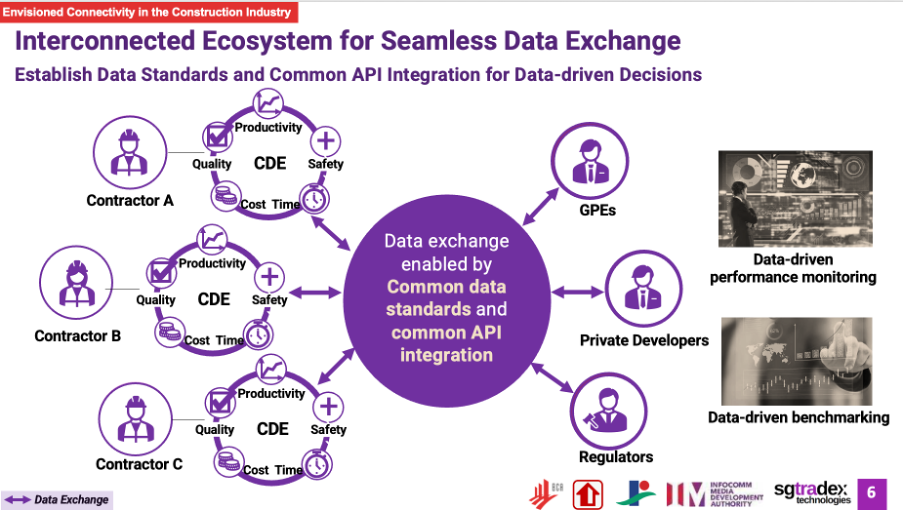
SGBuildex, powered by DEX, marks a pivotal shift in how data is exchanged across Singapore’s Built Environment sector. Rather than relying on fragmented, one-off integrations between systems, SGBuildex introduces a unified, secure data highway — enabling every participant to connect once and exchange information with all others through a trusted and interoperable platform.
By replacing the traditional web of many-to-many connections with a single point of connectivity, SGBuildex streamlines collaboration across developers, contractors, consultants, manufacturers, and government agencies — laying the foundation for a truly connected and data-driven ecosystem.
This hub-and-spoke architecture replaces the need for multiple bespoke integrations between systems. By enabling organisations to “connect once, connect to all,” SGBuildex streamlines collaboration across developers, contractors, consultants, manufacturers, government agencies, and other ecosystem partners.
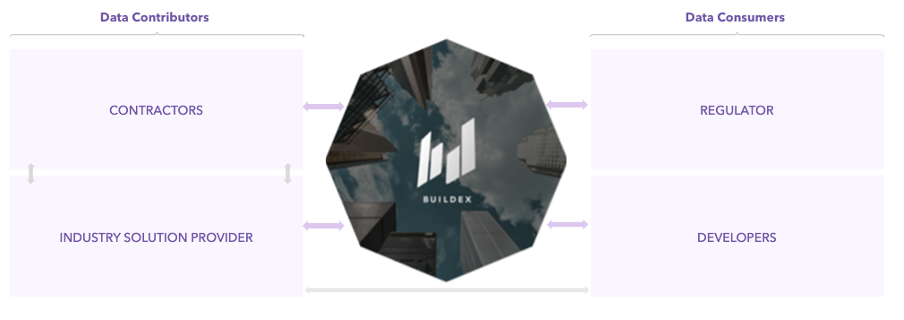
Fig X. Overview of Data Exchange Participants in SGBuildex
In the SGBuildex ecosystem, participants are broadly categorised as data contributors and data consumers.
- Data contributors — such as contractors and Industry Solution Providers (ISPs) — generate and submit project data arising from daily operations, covering domains like safety, quality, productivity, cost, and time.
- Data consumers, including regulators (e.g., the Building and Construction Authority) and developers or Government Procuring Entities (GPEs), utilise this data for regulatory oversight, project monitoring, and decision support.
By introducing a common platform that connects these parties through secure, standardised interfaces, SGBuildex enables structured, near-real-time data sharing — reducing duplication while improving visibility and trust across the construction value chain.

Figure X. The SGBuildex Data Highway Architecture
This architecture reimagines how data flows across the Built Environment ecosystem, replacing fragmented connections with a single trusted data highway. At the heart of SGBuildex lies a harmonised data schema, designed to ensure consistency and reliability while eliminating downstream inefficiencies caused by manual re-entry or incompatible formats.
Built in collaboration with BCA and HDB, and enabled by IMDA’s national digital infrastructure, SGBuildex provides a unified foundation for secure, standardised, and scalable data exchange across the construction lifecycle.
2.5. Key Features of the SGBuildex
At its core, SGBuildex functions as a trusted, API-based data exchange utility that enables secure, standardised, and efficient sharing of information across the Built Environment ecosystem. It provides a single point of connectivity for all data-sharing participants, supported by a robust consent and governance framework that allows organisations to manage data access, sharing, and revocation digitally.
Through a common API architecture, SGBuildex facilitates seamless “push” and “pull” transactions of harmonised data elements, ensuring consistency across systems while maintaining full control and ownership by data providers. All exchanges are protected by end-to-end encryption and strong authentication to ensure confidentiality and integrity of data in transit.
Built to scale, the platform supports high transaction volumes and multiple connection points (“pitstops”), enabling both direct integration from enterprise systems and access through a secure web portal. This ensures flexibility for organisations of varying digital maturity to participate and benefit from trusted data exchange.
2.6. Core Principles and Value Proposition
Underpinning SGBuildex are four design principles that define its role as a simplified yet secure data-sharing utility for the Built Environment sector.
Rather than re-stating its features, these principles describe the architectural intent and technical outcomes that guide its implementation.
- Single Point of Connectivity — Establishes a federated integration layer that allows organisations to connect once and interoperate with multiple partners through a common, secure endpoint. This reduces API proliferation and simplifies partner onboarding.
- Quality and Consistency — Implements harmonised data schemas and shared taxonomies to ensure data integrity and comparability across different systems, enabling analytics and cross-project benchmarking.
- Hassle-Free Flexibility — Supports multiple connectivity modes (API, proxy, or web portal) to accommodate varying digital maturity among stakeholders, ensuring inclusivity while maintaining interoperability.
- Security and Control — Operates on a non-replicative data-exchange model where no central storage is retained. Data remains under the owner’s domain, protected by end-to-end encryption, authentication, and enterprise-grade cybersecurity certification (ISO 27001, CSA CyberSafe).
 Together, these principles ensure that data sharing through SGBuildex is not only efficient and interoperable, but also governed by verifiable standards of security, integrity, and scalability — giving stakeholders confidence to exchange high-value, regulatory, and operational data seamlessly.
2.7. Collaborative Governance and Project Sponsorship
The success of SGBuildex is anchored in a strong public-sector partnership between three project sponsors — the Building and Construction Authority (BCA), the Housing and Development Board (HDB), and the Infocomm Media Development Authority (IMDA). Together, these agencies provide the strategic direction, policy alignment, and technical foundation that enable the sector’s digital transformation.
BCA serves as the regulator and industry lead, charting the Built Environment sector’s digitalisation roadmap and driving the adoption of common data standards and platforms. Its leadership ensures alignment between regulatory requirements, industry practices, and emerging technologies.
HDB, as a major public developer, demonstrates practical implementation and sectoral leadership through its large-scale public housing projects. By integrating digital solutions across its ecosystem of contractors and partners, HDB helps catalyse wider industry participation and showcases the operational value of data exchange platforms like SGBuildex.
IMDA, as the digital utility owner and enabler, provides the underlying infrastructure, technical oversight, and governance frameworks that power SGBuildex. Leveraging its experience in developing national digital utilities such as SGTraDex, IMDA ensures that SGBuildex is secure, interoperable, and scalable as part of Singapore’s digital public infrastructure stack.
Together, these project sponsors bring complementary strengths in policy, implementation, and technology — forming the foundation for a trusted, interoperable, and connected data ecosystem for the Built Environment sector.
- A Closer Look: How One Data Exchange Works on SGBuildex
To illustrate how SGBuildex functions in practice, this section explores a representative use case: how manpower and productivity data from builders are reported to the Building and Construction Authority (BCA), and how this process is re-architected through SGBuildex.
Beyond establishing the technical data-exchange pipeline, SGBuildex’s implementation begins with data consultancy — a collaborative process led by DEX, working with regulators (BCA), developers, contractors, and solution providers to determine what data should flow, how it should be structured, and which schema should serve as the sector standard.
This partnership ensures that when the exchange goes live, participants can easily onboard through a “connect once, share with all” model — using harmonised APIs and validations that reflect the sector’s collective design, not just a single system’s requirements.
3.1 Current State: How Builders Report Manpower and Productivity Data
Under Singapore’s Building Control (Buildability and Productivity) Regulations 2011, all qualifying construction projects (typically those exceeding 5,000 m² gross floor area) are required to submit monthly manpower and productivity data through the Electronic Productivity Submission System (EPSS). https://www.bca.gov.sg/epss/UserGuide/EPSS%20Guidebook_Oct2024.pdf
Each submission captures details such as total on-site workforce, trade composition, man-hours, and construction output — forming the basis for national productivity benchmarks and sector analytics.
How It Works Today
Builders collect workforce information from multiple internal systems — attendance tools, biometric records, payroll, and project management software. Data from these sources are manually compiled into BCA-prescribed templates (e.g., Excel or CSV) and uploaded monthly through the EPSS portal or secure file transfer (SFTP). Validation happens only after submission, often requiring resubmissions or clarifications with BCA officers.
This process creates a heavy administrative load: the same data must often be re-entered or reformatted for other reports (e.g., safety or developer dashboards), field definitions differ across systems, and monthly cycles delay visibility into emerging site trends.
In essence, Singapore’s construction sector generates abundant operational data daily — but fragmented systems and manual workflows limit its ability to be shared, trusted, and used in real time.
Figure A — “Current EPSS Data Flow”Purpose: Helps readers visualise the current fragmented, manual process without reading multiple paragraphs.
Suggested Layout: · Contractors / ISPs on the left (each with their own icons/systems). · Arrows pointing toward a manual compilation stage (spreadsheet, PDF, email). · Then a single upload arrow to EPSS portal (BCA). · Optional annotation: “Validation and error checks occur post-submission.” 🗝️ Key takeaway in caption: As-is data submission is fragmented and file-based, requiring repeated uploads and manual reconciliations. |
3.2 DEX’s Harmonisation Approach: Turning Fragmented Data into Shared Standards
To address fragmented reporting, DEX—on behalf of IMDA’s SGBuildex—works with BCA and industry partners to define how manpower and productivity data should be structured, shared, and governed. This begins long before the first API is built: through a consultative process, DEX helps the sector agree on what data matters, how it is represented, and which schema should serve as the common standard. Codified into reusable specifications, these agreements let new participants “connect once, share with all” through standardised, secure interfaces.
What DEX Provides
- Data consultancy: Map current workflows and sources, resolve inconsistencies, and design schemas aligned with national standards.
- Data-exchange utility: Provide the consent-based, secure exchange layer once the schema is agreed.
- Technical onboarding: Help organisations connect via standard APIs or a secure pitstop portal—accommodating different levels of digital maturity.
Working with Stakeholders (in practice)
Partnering with BCA and industry, DEX traces how data is collected, formatted, and submitted today. The findings inform a harmonised schema that aligns field definitions to ISO 8601 (dates), ACRA UEN (company identifiers), SG-DRM taxonomies, URA location codes, and ICA/MOM worker identifiers. Once validated, the schema becomes open API specifications with deterministic validation rules—ensuring interoperability across builders, ISPs, developers, and regulators.
Example: “Manpower Utilisation” (illustrative fields)
|
Field |
Standard / Description |
Example Validation |
|||
|
SubmissionMonth |
Date (YYYY-MM), ISO 8601 |
Must fall within project period |
|||
|
Contractor UEN |
Company ID (ACRA format) |
9–10 chars + check digit |
|||
|
PersonIDNo |
Worker ID (NRIC/FIN per ICA/MOM) |
Prefix + check digit |
|||
|
PersonTrade |
Standardised trade classification |
Must match approved list |
|||
|
|
|
(See Appendix A for a more detailed extract of the harmonised schema.)
|
Figure B — DEX Harmonisation Process |
With the schema agreed and validations defined, SGBuildex operationalises the standard—so data can flow automatically and consistently.
3.3 Connecting to SGBuildex: Pathways for Participation
The design of SGBuildex recognises that the Built Environment ecosystem is diverse — some firms run integrated management systems and APIs, while others rely on simple spreadsheets or web portals.
To ensure no organisation is left behind, SGBuildex was built around a simple idea: connect once, and participate at your own pace. Whether through full system integration or an intuitive web interface, every participant connects to the same trusted infrastructure and data standards.
3.3.1 Why SGBuildex is Designed This Way
In the past, every data submission or report had to be formatted and transmitted differently — one format for regulators, another for developers, and sometimes even another for internal dashboards.
SGBuildex removes this complexity by providing a single exchange layer that speaks a common language across the sector.
- For larger firms, this means automation and interoperability: data from existing systems can flow directly to authorised parties.
- For SMEs and contractors, it means accessibility and simplicity: the same data can be shared securely through a web portal.
- For regulators and developers, it means timeliness and transparency: validated data streams are immediately available for monitoring and insights.
This design approach was not theoretical — it was informed through real-world consultation with contractors, ISPs, and BCA’s regulatory teams during the development of manpower utilisation and productivity data standards.
Case Example — Manpower Reporting in Practice
Before SGBuildex, a main contractor managing 10 projects had to manually compile monthly manpower data from attendance and payroll systems, convert them into BCA’s EPSS template, and upload them individually through the portal.
Now, with SGBuildex, the contractor connects once — either through their attendance management ISP or directly through the Pitstop Portal. Data validated at source is shared instantly with BCA and the relevant developers, reducing manual handling from days to minutes.
3.3.2 Connection Pathways
|
Participant Type |
Connection Method |
Purpose and Experience |
|
Solution Providers / Large Builders |
API Integration |
Connect existing systems (e.g., attendance, project management, payroll) directly through standard APIs. Enables real-time, automated exchange of harmonised data. |
|
SMEs / Non-technical Teams |
Pitstop Portal |
A web-based interface to share and receive data securely, guided by templates aligned with the national data dictionary. No coding required. |
|
Regulators / Developers / GPEs |
Admin Portal + API |
Manage consents, define relationships, and receive validated data directly into internal systems for monitoring and analysis. |
|
Figure C — One Exchange, Multiple Ways to Connect |
3.3.3. How It Works in Practice
Each connection type ultimately serves the same purpose — to enable participants to share or receive trusted data securely and consistently.
Through APIs
Digitally mature firms or ISPs integrate once, pushing validated data automatically into the exchange. Their systems can also receive notifications and updates on transaction status — ensuring a live connection to the sector’s data flow.
Through the Pitstop Portal
Contractors and SMEs without backend systems can use a simple web interface to upload manpower data directly, establish consent with their partners, and view live dashboards showing shared and received information.
Through the Admin Portal
Sector regulators and project owners manage relationships and permissions — defining who can contribute or consume each data element (e.g., productivity metrics, safety data). These relationships create digital “pipes” that remain reusable across projects.
3.3.4 Why It Matters
SGBuildex’s multi-pathway architecture ensures the whole ecosystem advances together:
- SMEs can participate without large IT investments.
- ISPs can integrate directly and scale efficiently.
- Regulators and developers receive high-quality, validated data without manual intervention.
By aligning every participant around the same data dictionary and consent model, SGBuildex turns what was once a fragmented, manual process into a collaborative digital network.
The design reflects a simple truth: digital transformation succeeds only when everyone can plug in, not just the most advanced.
3.4 Participant Onboarding Journey: From Connection to Collaboration
To make participation straightforward, SGBuildex streamlines onboarding into a clear, guided journey — transforming what used to be a weeks-long IT exercise into a short setup process.
Step 1 — Registration and Access
Organisations register once through the Admin Portal. Designated Super Admins set up company profiles, add users, and assign roles — such as Admin, Operations, or Technical — each with defined permissions.
Step 2 — Establish Relationships and Consents
Within the portal, participants define whether they will contribute (share) or consume (receive) specific datasets, such as Manpower Utilisation.
Both parties approve the relationship digitally, creating a consent artefact that governs all subsequent exchanges — a step that replaces traditional email approvals or static user lists.
Step 3 — Configure and Test Connections
- Portal users: Upload datasets directly through pre-formatted templates in the Pitstop Portal.
- API users: Configure authentication tokens, test endpoints, and send sample payloads through the SGBuildex test environment.
Every submission is validated automatically for schema accuracy and field-level rules before being accepted.
Step 4 — Go Live
Once validated, data begins flowing securely to authorised recipients. Each transaction is encrypted and traceable via dashboards showing submission status, transaction counts, and validation results.
|
Figure D — Participant Journey on SGBuildex |
3.5 Impact and Outcomes: From Reporting to Real-Time Intelligence
3.5.1 Measuring the Transformation
The introduction of SGBuildex has transformed manpower and productivity reporting from a monthly compliance task into a near real-time information flow.
Where builders once spent days collating and submitting data through multiple portals, they now transmit validated data directly from their systems — once — to all authorised parties.
|
Impact Area |
Before (EPSS Workflow) |
After (SGBuildex Exchange) |
|
Submission process |
Manual collation and upload per project |
Automated, consent-based data exchange |
|
Data validation |
Performed post-submission by BCA |
Built-in validation at source |
|
Timeliness |
Monthly, lagging indicators |
Live, rolling updates |
|
Data consistency |
Fragmented templates and differing standards |
Unified schema across projects |
|
Effort |
Hours of manual reformatting |
Minutes via automation or portal upload |
Quantitative benefits observed in early pilots:
- > SGD XXX,XXX annual productivity savings from five initial data elements harmonised through SGBuildex.
- > 10× reduction in reporting time — from several days per cycle to less than one hour.
- Error rate reduction through built-in schema validation and automated error prompts.
- Live dashboards enabling regulators and developers to monitor workforce levels across projects in real time.
- Scalability — potential for over >180 harmonised data elements to extend beyond manpower utilisation into safety, site management, and quality metrics .
3.5.2 Benefits Across the Ecosystem
For Regulators (e.g., BCA)
- Real-time, validated data improves sector-wide visibility.
- Automated validation reduces manual data-checking workloads.
- Live dashboards provide consolidated oversight across projects.
For Developers and Government Procuring Entities (GPEs)
- Direct access to reliable data from contractors and ISPs.
- Improved monitoring of manpower deployment, safety, and productivity.
- Reduced administrative back-and-forth during audits or progress reviews.
For Contractors and ISPs
- Compliance made seamless — single submission to multiple stakeholders.
- Integration options suit both advanced systems and small-scale firms.
- Trusted data pipelines support analytics and AI-driven optimisation.
For the Sector as a Whole
- A common digital backbone promotes interoperability and trust.
- Reduced friction across regulatory and commercial data exchanges.
- Enables predictive insights and sector-level benchmarking — setting the foundation for AI-assisted decision-making.
SGBuildex exemplifies how a well-governed, neutral digital utility can unlock systemic efficiencies.
By embedding common standards and secure, consent-based data exchange into daily operations, the initiative has transformed regulatory reporting into a shared infrastructure for continuous insight.
It demonstrates that when public-sector leadership (IMDA, BCA, HDB) and industry collaboration converge around open standards, digitalisation ceases to be a compliance burden — it becomes a competitive advantage.